Every day, thousands of US small business owners launch a new website, admire the shiny home page, and wait for the phone to ring. Nothing happens. The fix is rarely more traffic. In most cases, the fix is custom WordPress web design built around how your business actually earns money.
If your website looks fine but your inbox is a ghost town, you don’t have a traffic problem. You have a conversion problem.
Many agencies install a pre-made theme, change the colors to match your logo, and call it a day. At DQN Digital, our team has spent years fixing these template-reliant sites for verified Upwork clients around the world. One lesson keeps repeating: if a website isn’t built around how your business makes money, it’s just an expensive digital business card.
Here is the unfiltered reality of why generic templates cost you leads, and how custom WordPress architecture changes the game.
Table of Contents
What Is Custom WordPress Web Design?
Custom WordPress web design means your site’s layout, components, and user journey are planned and built for your business specifically, instead of being bent to fit a theme designed for thousands of other buyers. You still get everything that makes WordPress great: easy editing, a huge plugin ecosystem, and full ownership of your content. What changes is the foundation underneath.
A template asks, “Where can we fit your content?” A custom build asks, “What should a visitor see, feel, and do in the first five seconds?” That difference shows up directly in your lead count. If you’re still choosing a platform, our comparison of WordPress vs Wix vs Squarespace explains why WordPress is usually the right base for a growing business.
The Hidden Cost of Cheap Templates (What Agencies Don’t Tell You)
It is easy to buy a $59 theme from ThemeForest. It is much harder to clean up the operational mess it leaves behind. When you put a generic template on a small business site, you inherit three major bottlenecks:
- Code bloat overload: Templates are built to serve everyone, from a flower shop to a corporate law firm. That means they ship with thousands of lines of unused CSS, JavaScript, and slider settings. The result? Your site loads like molasses on mobile, hurting your mobile-first SEO before you even start.
- Broken UX maps: A template dictates where your text goes. A custom WordPress site dictates where your visitor’s eyes go. If your main call-to-action (CTA) sits below the fold because the template demanded a large stock photo, you are throwing away hard-earned traffic.
- The “plugin nightmare” dependency: To make a template work, generic builders stack 20+ heavy plugins for simple contact forms or styling tweaks. One bad update over the weekend, and your contact form breaks right when a high-intent US lead tries to reach you.
These problems rarely show up on launch day. They show up months later as slow pages, slipping rankings, and a contact form nobody fills in.
Custom WordPress Web Design vs. Templates: Side-by-Side
| Factor | Generic template | Custom WordPress build |
|---|---|---|
| Page weight | Ships code for every possible layout | Only the code your pages actually use |
| Mobile layout | Desktop design squeezed onto a phone | Mobile layout planned on its own |
| Calls-to-action | Placed wherever the theme allows | Placed where visitors actually look |
| Plugins | Often 20+ to patch missing features | Only essential, well-maintained plugins |
| Updates | One bad update can break the layout | Lean setup that is easier to maintain |
| SEO foundation | Added later, if at all | Built in from day one |
How We Engineer Custom WordPress Architecture for More Inquiries
When we build at DQN Digital, we work backwards from the transaction. Our custom WordPress websites use lightweight, scalable block layouts designed for speed, clear navigation, and conversion tracking. Every build rests on three pillars.
1. Mobile-First Layout Mapping
A large share of searches for US home services and local businesses now happen on a phone. A custom approach means we plan the mobile layout on its own, not as a shrunken desktop page. We tune the visual hierarchy so your phone number, contact link, and value proposition reach visitors the moment they land.

2. Radical Speed Auditing
Speed is where custom WordPress web design pays off fastest. Every page we build is audited against Google’s Core Web Vitals before launch, targeting a mobile load time (LCP) under 2.5 seconds. Clean, purpose-built block components keep pages light, so visitors don’t bounce out of frustration.
3. Direct Lead Capture Funnels
We map your business goals directly into the layout. Instead of generic “Submit” boxes, we build contextual, multi-step forms that filter out spam while keeping high-intent leads engaged.
Our 4-Step Custom WordPress Web Design Process
Every project follows the same four phases, so you always know what happens next:
- Discovery: We learn how your business makes money, who your best customers are, and where your current site loses them.
- Planning: We map pages, user journeys, and calls-to-action before any visual design starts.
- Engineering: We design and build the site with lean custom blocks, with on-page SEO and tracking baked in.
- Launch & Optimization: We test, launch, and keep refining based on real visitor behavior.
A typical custom WordPress web design project takes 3–6 weeks, depending on scope and assets. For budgeting, see our breakdown of how much a business website costs.
Direct Communication vs. The Agency Runaround
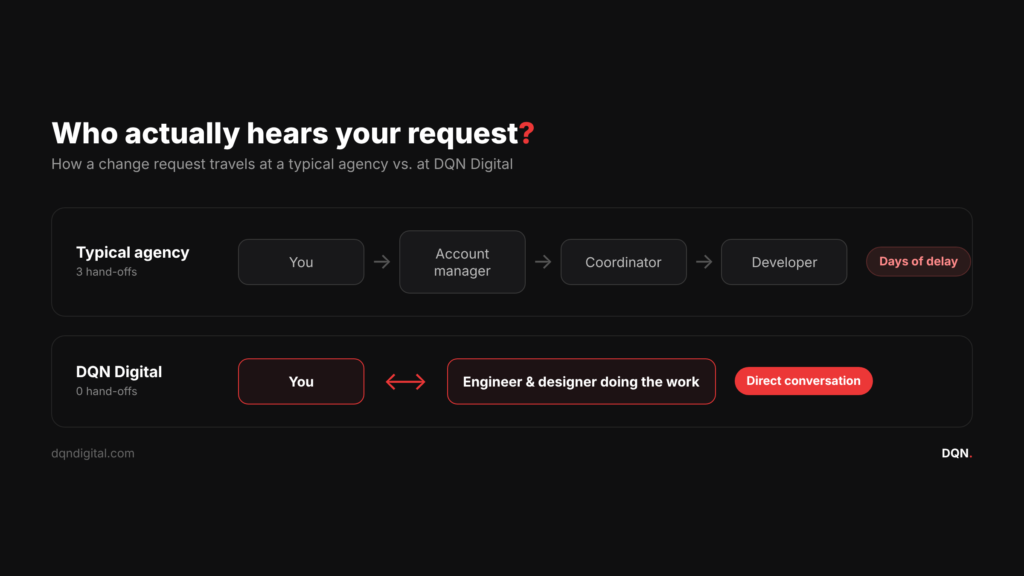
The biggest bottleneck in getting your website right isn’t code. It’s communication. Most corporate marketing agencies trap small businesses in a frustrating loop: you explain your issue to an account manager, who passes it to a coordinator, who routes a garbled version to the developer days later.
We built DQN Digital specifically to remove that lag. When you partner with us, you talk directly to the engineers and designers doing the work.
“Muhammad brought strong leadership and clarity to every task. His ability to communicate clearly, solve problems quickly, and keep everyone aligned made him a critical part of our success.”
William M., Verified Upwork Client
Common Web Design Mistakes to Avoid This Quarter
- Mistake 1: Prioritizing aesthetics over conversion. A hyper-stylized minimalist site with unclear navigation impresses designers but confuses your real customers.
- Mistake 2: Skipping SEO foundations at launch. Doing SEO months after the site goes live means recoding structural errors. On-page schema and speed optimization belong in the build from day one.
- Mistake 3: No post-launch support plan. Launch day isn’t an exit strategy. If your developer vanishes once the final invoice clears, your business is exposed the moment systems need updates.
Running a local business? Our guide to small business website design in Austin shows how these mistakes play out in a real local market.
Frequently Asked Questions
Why is custom WordPress web design better than pre-made templates?
Custom WordPress design eliminates excessive code bloat, optimizes site speed, and ensures that visual conversion maps focus entirely on generating customer leads rather than generic visual filler.
How long does a custom business website redesign take to launch?
A standard professional custom build goes through four core phases: Discovery, Planning, Engineering, and Launch/Optimization. This typically takes 3–6 weeks, depending on project complexity and asset requirements.
Build a Digital Presence That Actually Drives Revenue
Your US business deserves better than a recycled template. If you’re ready to fix slow load times, close communication gaps, and finally grow your monthly inquiries, it’s time to invest in custom WordPress web design built to convert.
Ready to start? Message us directly on WhatsApp (+1 786 796-4044) or visit our Contact Page to request a transparent, line-item quote for your next project.
About the Author: Written by the core engineering and strategy team at DQN Digital. With 62+ successfully completed contracts and Top-Rated status on Upwork, we build data-backed web platforms that help small businesses scale.