
By DQN Digital | Last updated: October 2026
Generative Engine Optimization (GEO) is the practice of structuring web content so AI search tools such as ChatGPT, Google AI Overviews and Perplexity can find, summarize and cite it. Instead of competing for a blue link, GEO aims to make your brand the source that an AI-generated answer names.
Gartner predicted that traditional search engine volume would fall 25% by 2026 as people move to AI chatbots and virtual agents. That shift means businesses now need to write for AI retrieval as well as for human clicks.
Key takeaways
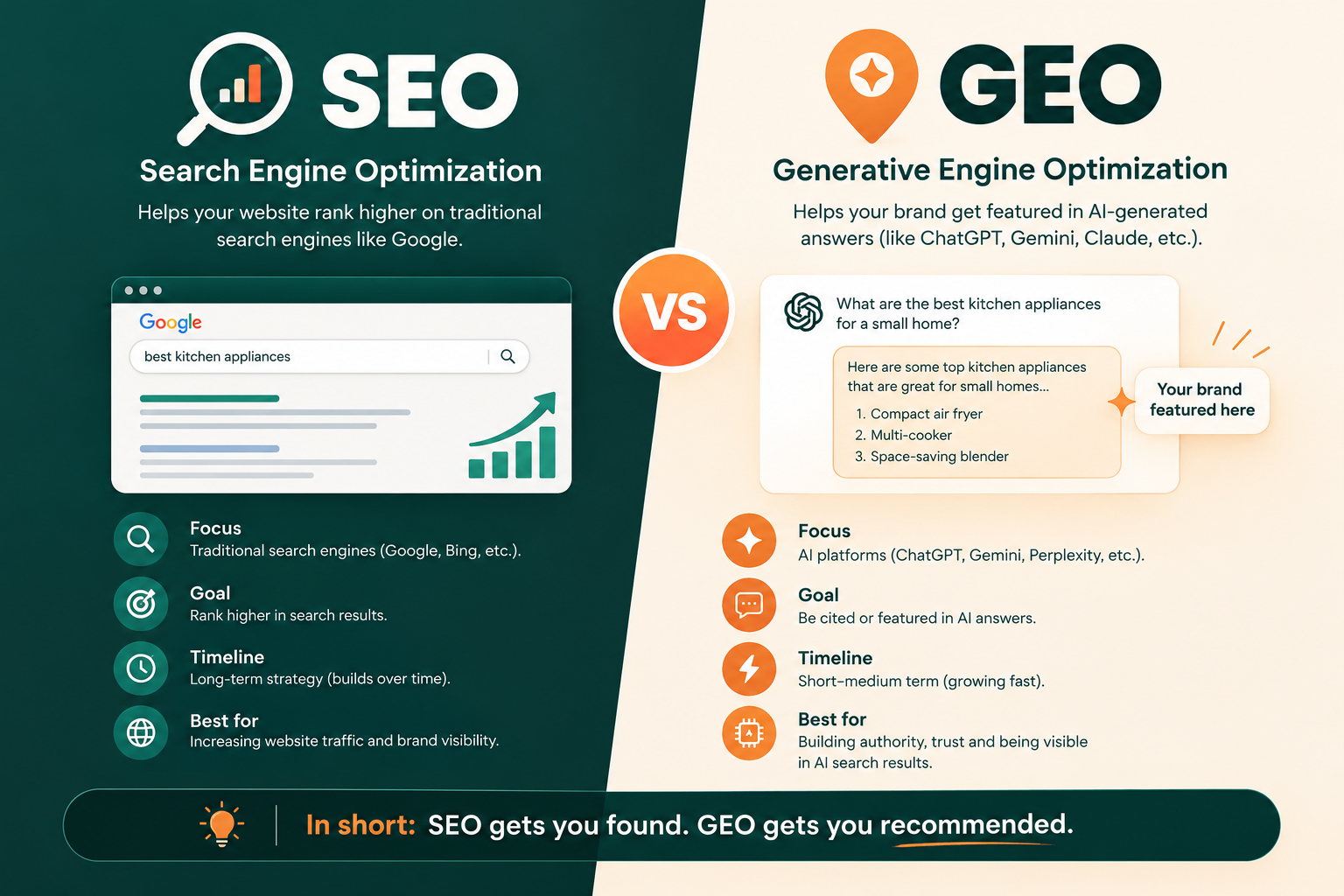
Traditional SEO aims to rank your page so people click it. GEO aims to get your brand cited inside the answer an AI tool gives. The two work together: Generative engine optimization is an extra layer on top of solid technical SEO, not a replacement for it.
| Traditional SEO | GEO | |
|---|---|---|
| Main goal | Rank higher and win the organic click | Earn brand citations inside AI answers |
| Audience | People scanning search results | Large language models (LLMs) combining several sources |
| Content focus | Keywords, headings and meta descriptions | Answer-first sections, structured data and tables |
| Key metrics | Organic traffic, click-through rate, keyword position | Share of voice, citation rate and sentiment |
Generative engine optimization works because many AI search tools use retrieval-augmented generation (RAG). They split web pages into small chunks, pull the chunks that best match a question, and write an answer from them. One prompt can also trigger several related searches, known as query fan-out. So your content needs clear, self-contained sections that answer the main question and the questions around it.
Discovered Labs, a marketing research firm, reports that content following a clear framework is cited up to 2.8 times more often by ChatGPT. Here are the five parts covered in this guide.
AI crawlers such as GPTBot and ClaudeBot do not need long introductions. Put the bottom line up front. Write each heading as a question and answer it in 40 to 60 words straight away. Use your brand name instead of “we” or “our”, so AI tools can connect your expertise to your business.
One prompt can lead to many sub-questions. Cover the topics around your main answer: What is it? How much does it cost? How does it compare with the alternatives?
AI tools look beyond your own website for proof. Keep your brand mentioned consistently on sources that are often cited, such as Reddit, Wikipedia, G2 and industry forums.
Specific numbers beat vague claims. Instead of “our software speeds up operations”, write “our system reduced server load times by 43% within 60 days, based on our 2026 case study” (example figures). Quantitative claims are reported to earn about 40% more citations than general statements.
Write in stand-alone sections of 200 to 400 words. Use numbered lists and proper HTML tables. Content with data tables is reported to be cited about 2.5 times more often.
A robots.txt file that allows these crawlers can look like this:
User-agent: GPTBot Allow: / User-agent: OAI-SearchBot Allow: / User-agent: ClaudeBot Allow: /
One study found that 76.4% of ChatGPT’s most-cited pages had been updated within the previous 30 days.Refresh your best pages at least every quarter, and the pages you most want AI tools to cite every month.
No. GEO is built on strong technical SEO. A site that crawlers cannot access or understand will not be cited by AI tools either.
GEO targets AI-powered search tools such as ChatGPT, Google AI Overviews and Perplexity.
Track share of voice, citation rate and sentiment: how often AI answers mention your brand, how often they link to you, and how positively they describe you.
Yes. Organization, Article and FAQ schema give search engines a clear map of your content and brand, which helps Google AI Overviews connect the dots.
Generative engine optimization turns your content into source material for large language models. Content is no longer only a digital brochure that attracts clicks. It is source material for large language models. Brands that make their expertise clear, honest and easy to extract are more likely to appear in AI-generated shortlists, and one report claims visitors from AI search convert at 2.4 times the rate of traditional search.
Want to know if your website is ready for AI search? Request a free audit from DQN Digital at dqndigital.com/free-audit.